
Male Pattern Hair Loss Treatments at The Hair Loss Clinic UK
The Hair Loss Clinic offers expert advice and scientifically proven treatments to regrow your hair if you are struggling with Male Pattern Hair Loss, also known as Androgenetic Alopecia.
MPHL is one of the most common causes of thinning hair in men. For some, it begins with a receding hairline at the temples, while others notice thinning around the crown or widening areas of scalp visibility. Hair loss can develop gradually over time or progress more rapidly depending on genetics, hormones, age, and lifestyle factors.
Experienced Trichologist Stephen James and his team offer advanced, medical-grade topical treatments designed to help slow hair loss, reduce excessive shedding, and encourage healthy hair regrowth.
We support both men and women experiencing Male Pattern Hair Loss (MPHL) and Female Pattern Hair Loss (FPHL) with clinically backed treatment plans tailored to individual needs.
We can diagnose a variety of hair and scalp conditions and will either:
- direct you to our online portal offering subscription-based professional-grade hair loss serums
- offer you a quick at-home genetic swab test to guide us on which treatment is best suited to your genetics; or
- point you to the most appropriate specialist for your needs.
Key Takeaways:
✔ We offer scientifically proven treatments to regrow your hair if you have Male Pattern Hair Loss
✔ Our qualified consultant trichologist will assess your needs
✔ We also offer genetic testing to help identify which treatments you will best respond to
✔ Start your hair recovery plan by completing our online hair questionnaire
Understanding Male Pattern Hair Loss
Male Pattern Hair Loss is primarily linked to a hormone called DHT (dihydrotestosterone). DHT is a by-product of testosterone and can gradually shrink hair follicles in genetically sensitive individuals. Over time, affected follicles produce finer, weaker hairs until growth slows dramatically or stops altogether.
This process is known as follicular miniaturisation and most commonly affects:
- The temples and frontal hairline
- The crown or vertex area
- The mid-scalp
While hair loss is extremely common, early intervention is important. The sooner treatment begins, the better the chances of preserving existing hair and encouraging regrowth. At The Hair Loss Clinic we can guide you to the right hair loss treatment for you, offering online hair serums via monthly subscription.

Thinning Hair & Receding Hairlines
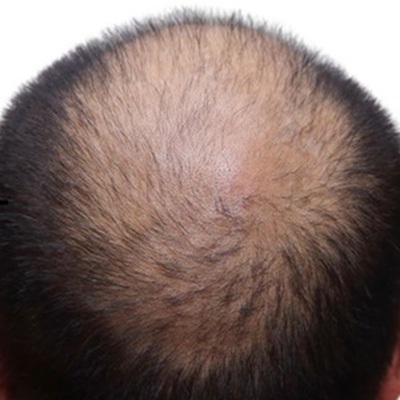
One of the earliest signs of MPHL is a receding hairline. Many men notice thinning at the temples which gradually creates an 'M-shaped' appearance. Others may first spot thinning around the crown where the scalp becomes more visible under bright lighting.
Our trichologist will carefully assess the pattern and severity of your hair loss before recommending a personalised treatment plan. It's worth noting that hair follicles that have recently miniaturised are generally more responsive to treatment than follicles that have been dormant for many years. Seeking professional advice early can help:
- Slow ongoing hair loss
- Preserve existing hair density
- Improve scalp health
- Encourage stronger regrowth
Even if hair loss has progressed significantly, treatment may still help improve the appearance and quality of your remaining hair.
Clinically Proven Hair Loss Treatments
The Hair Loss Clinic UK provides hair loss solutions for men and women across the UK. All our pharmaceutical-grade topical solutions are overseen by our Trichologist and prescribed by our partner pharmacy. We recommend clinically proven treatments to support hair growth and reduce shedding, including:
- Finasteride: Finasteride reduces the conversion of testosterone into DHT, which slows the miniaturisation of hair follicles to preserve hair and encourage regrowth.
- Dutasteride: Dutasteride is another DHT-blocking treatment that blocks a broader range of DHT production pathways.
- Minoxidil: Minoxidil stimulates blood flow to the scalp and prolongs the hair growth cycle. It can help improve hair density, strengthen weaker hairs, and support regrowth in thinning areas.
While you may have come across online hair loss products containing these ingredients, many contain a low % or a less effective combination of active ingredients. Our treatments are available online and include quality products designed for your specific hair loss journey.

Get The Best Hair Loss Solution With Genetic Testing
No two cases of hair loss are exactly the same. Genetics, hormones, age, lifestyle, stress, and overall health can all influence how hair loss develops.
That is why The Hair Loss Clinic UK offers personalised treatment plans rather than a one-size-fits-all approach.
Using an at-home genetic testing kit (the Fagron TrichoTest™), we can help determine which treatments may be the best fit for your unique genetic profile.
The genetic test is a simple and non-invasive procedure that only requires a saliva sample. This sample is sent for laboratory analysis and reviewed to help guide us to your genetic hair loss factors.
By understanding how your body may respond to certain ingredients and medications, we can create a more targeted and effective approach to hair restoration. This gets rid of the 'trial and error' you may experience as it tells us which pharmaceutical ingredients you will best respond to.

What Is The Norwood Scale?
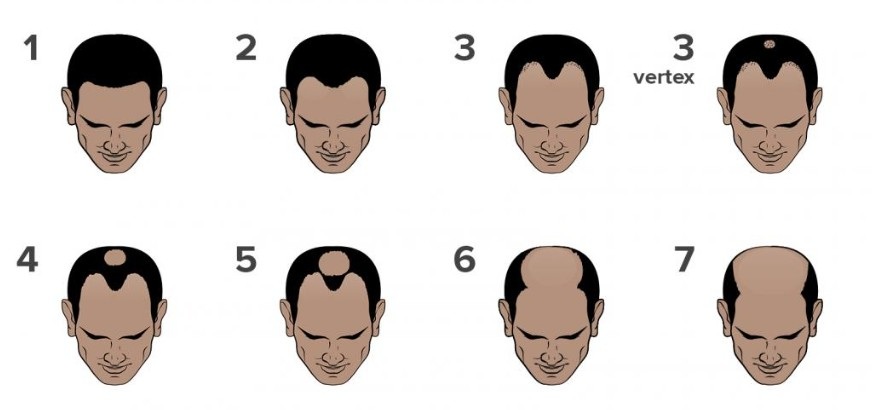
The Norwood Scale is the most widely used classification system for Male Pattern Hair Loss. It helps identify the stage and progression of hair loss.
The stages include:
Stage 1: Minimal or no visible hair loss
Stage 2: Slight recession around the temples
Stage 3: More noticeable recession and early balding
Stage 3 vertex: This is a less drastic version of stage 3.
Stage 4: Significant hairline recession and crown thinning
Stage 5: Larger areas of hair loss begin to merge
Stage 6: Extensive thinning across the scalp
Stage 7: Advanced hair loss with a narrow band of hair remaining
Understanding your Norwood stage helps our trichologists determine the most effective treatment options for your hair loss concerns.
FAQs About Male Pattern Hair Loss
What is Male Pattern Hair Loss?
«Male Pattern Hair Loss, also known as Androgenetic Alopecia, is the most common form of hair loss in men. It is usually caused by a combination of genetics and sensitivity to the hormone DHT, which gradually shrinks hair follicles over time.
What are the first signs of Male Pattern Hair Loss?
«The earliest signs often include a receding hairline around the temples, thinning hair at the crown, or increased scalp visibility under bright lighting. Some men also notice more hair shedding when washing or styling their hair.
Can Male Pattern Hair Loss be treated?
«While Male Pattern Hair Loss cannot always be completely reversed, early treatment can significantly slow the progression of hair loss and help encourage regrowth. At The Hair Loss Clinic, we offer medical-grade topical treatments tailored to individual needs and hair loss stages. Your first step is to take our online questionnaire which will help guide our trichologist to the right treatment pathway for you.
How does DHT affect hair loss?
«DHT, or dihydrotestosterone, is a hormone linked to Male Pattern Hair Loss. In genetically sensitive individuals, DHT causes hair follicles to shrink gradually, leading to thinner, weaker hairs and eventually reduced hair growth over time.
What treatments are available at The Hair Loss Clinic?
«Our trichologist and his team offer clinically proven pharmaceutical solutions including topical Minoxidil, Finasteride, Dutasteride, Tretinoin, Melatonin and Spironolactose serums. These products are designed to reduce shedding, slow thinning, and support healthier hair growth.
What is Minoxidil and how does it work?
«Minoxidil is a clinically proven hair loss treatment that helps stimulate blood flow to the scalp and prolong the hair growth cycle. It may help improve hair density, strengthen weaker hairs, and encourage regrowth in thinning areas.
What is the difference between Finasteride and Dutasteride?
«Both Finasteride and Dutasteride work by helping reduce DHT levels, but Dutasteride blocks a broader range of DHT pathways. Your trichologist will recommend the most suitable option depending on your hair loss pattern and treatment goals.
Do I need to take a genetic test?
«No, you do not need to take a genetic test. We can still offer effective hair loss serums without you taking this test. However, our at-home genetic testing kits are a great way to get rid of the 'trial and error' you may experience when trying to find the most effective treatment for you. Genetic testing helps us to identify which treatments may work best for your individual genetic profile. This allows us to create a more personalised treatment plan designed for optimal results.
When should I seek help for thinning hair?
«The sooner you seek professional advice, the better the chances of preserving existing hair and encouraging regrowth. Early treatment can help slow progression before hair follicles become too weakened or inactive to respond effectively. Your first step should be to take our online hair loss questionnaire.
How do I get started?
«Your first step is to take our online hair loss questionnaire. This asks you some detailed questions to give our trichologist a better idea of what type of hair loss you are experiencing. He can then devise the right pathway for you. If all looks straight-forward, you may simply be directed to the most appropriate pharmaceutical grade hair loss serum via our online portal. If you do not have male pattern hair loss, we may direct you to one of our partner specialists who can help. In some casees, we may recommend you start with a simple at-home genetic test (a mouth swab).